
StarDist – Basic Example#
Source: stardist/stardist
Additional info (FAQs): https://stardist.net/index.html
ImageJ documentation: https://imagej.net/plugins/stardist
Uwe Schmidt, Martin Weigert, Coleman Broaddus, and Gene Myers.
Cell Detection with Star-convex Polygons.
International Conference on Medical Image Computing and Computer-Assisted Intervention (MICCAI), Granada, Spain, September 2018.
Martin Weigert, Uwe Schmidt, Robert Haase, Ko Sugawara, and Gene Myers.
Star-convex Polyhedra for 3D Object Detection and Segmentation in Microscopy.
The IEEE Winter Conference on Applications of Computer Vision (WACV), Snowmass Village, Colorado, March 2020.
StarDist is a deep learning tool to segment star-convex shapes (usually blobs, such as cells or nuclei). It can be installed as a FIJI plugin. Add StarDist through Update > Manage Update Sites. Also add the CSB Deep plugin (https://imagej.net/plugins/csbdeep):
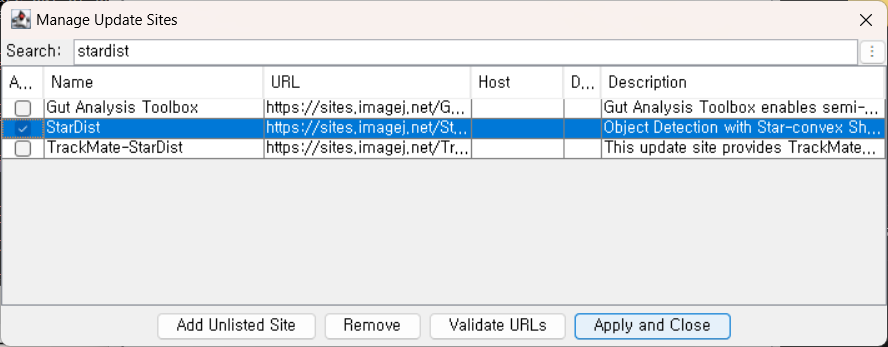
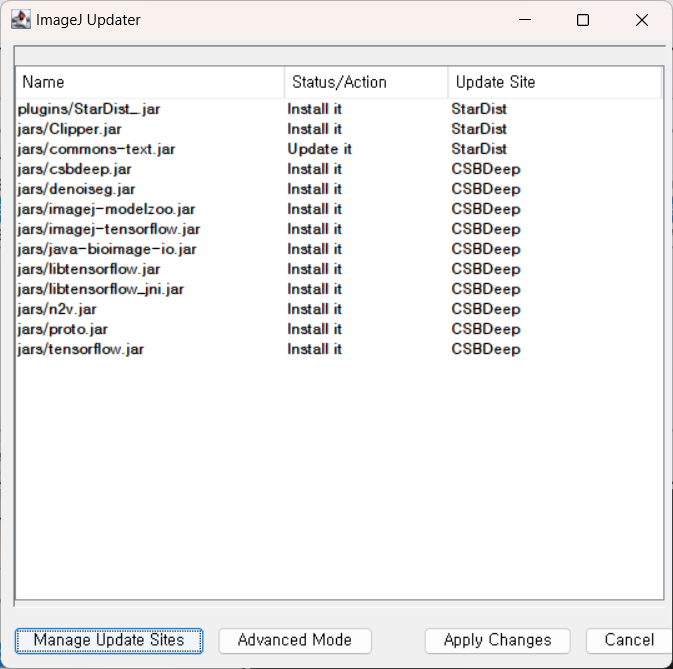
As of May 2025, libraries which use TensorFlow 1.15 have a conflict with the built-in version of
protobuf-javaversion 4. To avoid this we also add the TensorFlow plugin, which includesprotobuf-javaversion 3.28, and remove (delete)protobuf-java-4.xx.yy.jarfrom theFiji.app/jarsdirectory before restarting Fiji.
You can also download the latest version of protobuf-java-3 from Mvn Central and place it in
Fiji.app/jars. At the time of writing, the latest version is 3.25.7: download page, direct download link.
Open the blobs image as a simple test case: File > Open Samples > Blobs.
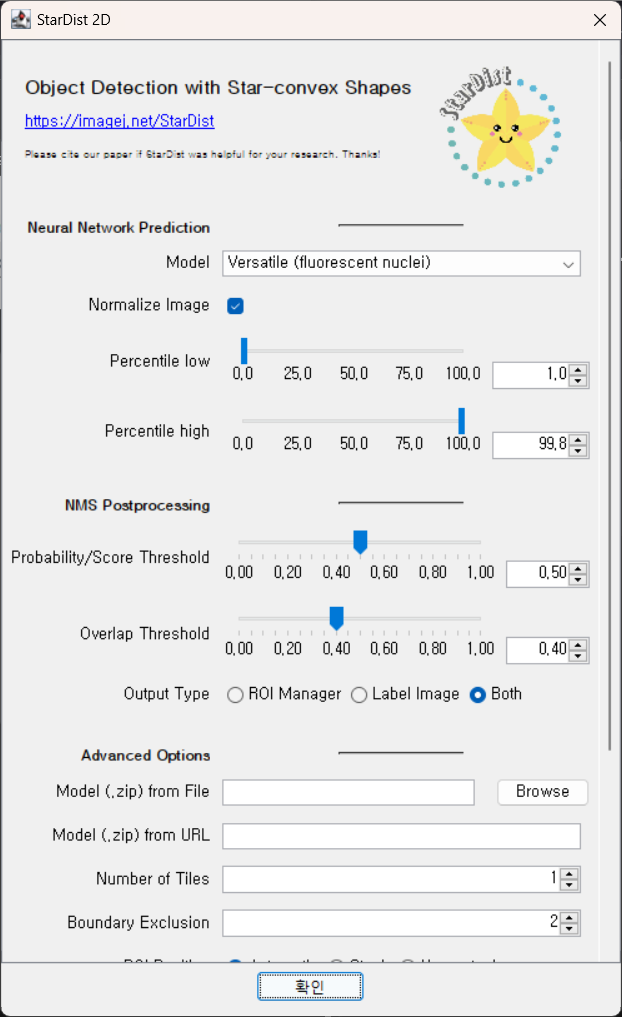
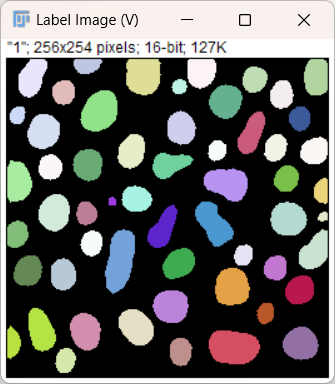
Run Plugins > BIOP > StarDist > StarDist2D. If we run with the default parameters, shown below, with the “Versatile (fluorescent nuclei)” model we get the following result.
a. The other options for the Neural Network Prediction allow us to adjust the percentile for image normalization.
b. NMS (non-maximum suppression) Postprocessing parameters operate as follows[1]:
- Probability/Score Threshold – higher values lead to fewer segmented objects, but will likely avoid false positives.
- Overlap Threshold – higher values allow segmented objects to overlap substantially.c. Advanced options can be used to apply a user-trained model.
We can also test this using the image
trackmate_example_data.tiffor a timeseries example. Again run with default settings.